Buddhism
莫高窟
Mogao Caves
“Caves carved into a desert cliff over a thousand years, where the Buddha crossed”
Photo: xiquinhosilva · CC BY 2.0
Scenes
Meaning
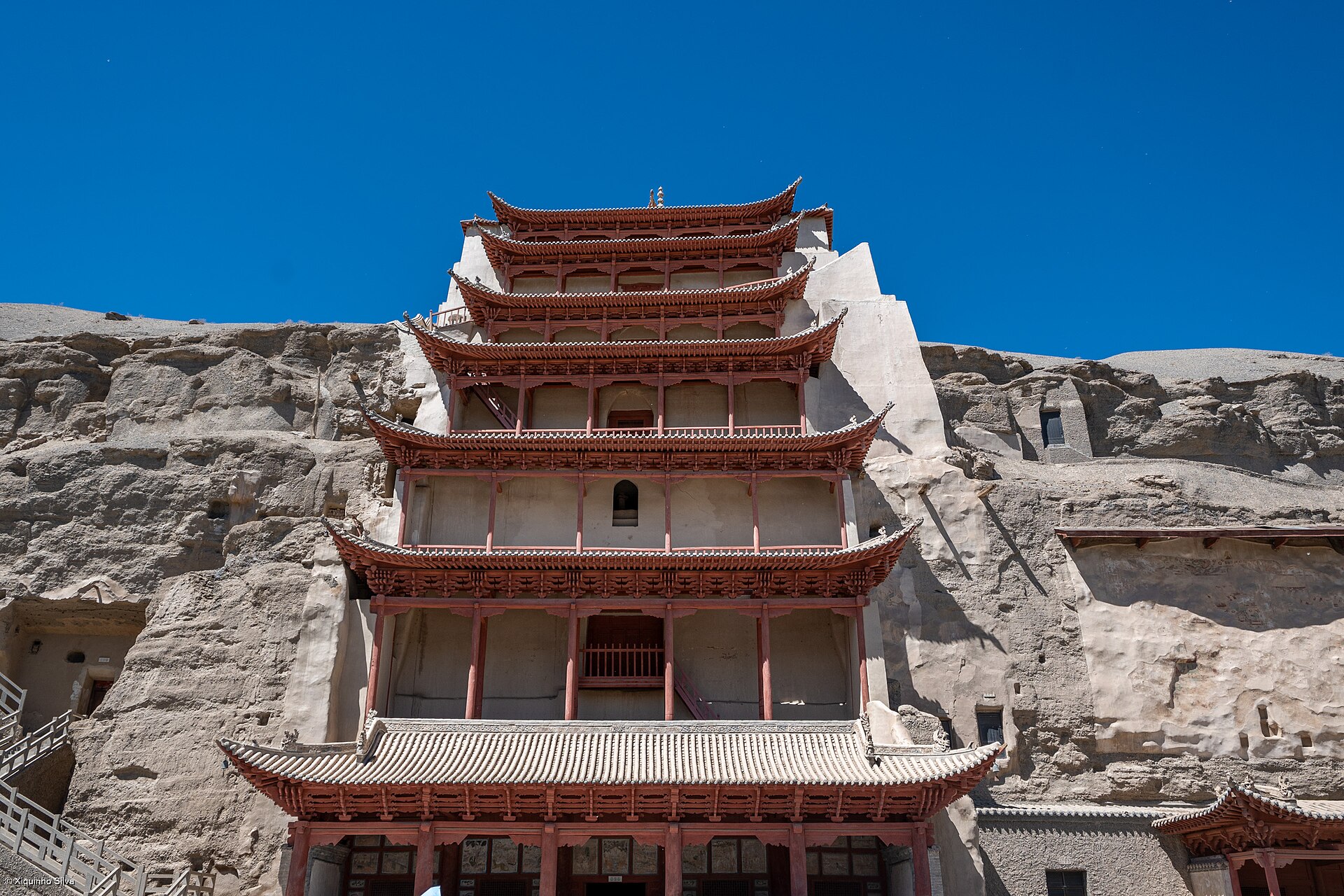
In the dry desert wind the cliff is honeycombed with openings, and a red nine-story tower keeps watch before it. Enter the dark caves and the Buddhas and flying celestials painted a thousand years ago come alive in lamplight — wall by wall, the road from India to this desert runs on.
In the cliff southeast of Dunhuang, an oasis city on the Silk Road, a complex of Buddhist caves was carved over a thousand years beginning around the 4th century, hundreds of grottoes holding murals and sculpted Buddhas. It is regarded as a witness to how Buddhism, arriving from India and Central Asia, passed eastward into China along the desert trade routes; a vast cache of manuscripts was found in a sealed library cave in the early 20th century. A UNESCO World Heritage Site.
Voices across time
“On a moonlit night I gaze toward the road home; only drifting clouds return that way.”
Roads through this light
Field notes
- Location
- Dunhuang · China · N40.0° · E94.8°
- Best time
- Spring and autumn, when the desert light is soft; visits are by reservation
- Getting there
- About 25 km southeast of Dunhuang in Gansu; visits are booked and guided to a set of caves.
- Etiquette
- To protect the murals, photography inside the caves is restricted; follow the set visiting rules.
Sources
- · UNESCO World Heritage
- · Dunhuang Academy
Photographs are freely licensed works from Wikimedia Commons and similar sources; the author and license appear beneath each image.