Buddhism
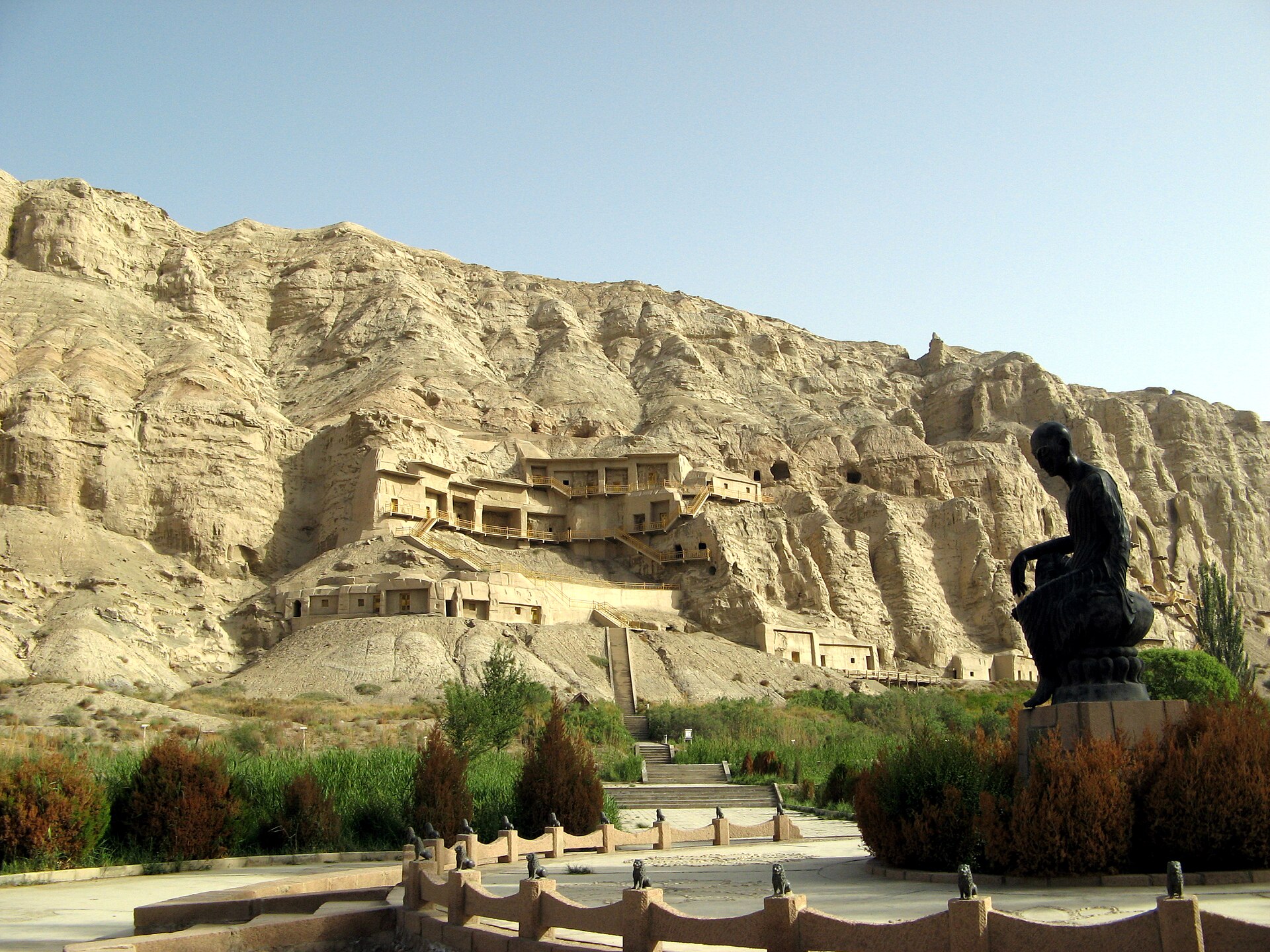
克孜尔千佛洞
Kizil Caves
“Under a lapis sky, the Buddha's past lives painted in every diamond — the caves of Kucha”
Photo: G41rn8 · CC BY-SA 4.0
Scenes
Meaning
Along a red sandstone cliff by the Muzart River, cave mouths open in a long row. Step into the dark, and the vaulted ceilings deepen into lapis blue, each diamond panel unfolding a tale of the Buddha's past lives — the colors carried from India flowering anew in these desert caves.
Scholarship regards these as one of the earliest Buddhist cave complexes in China, begun around the 3rd century in Kucha on the northern rim of the Tarim Basin. The murals surviving in more than two hundred caves — jataka tales painted in diamond panels on lapis-blue grounds — are understood as a link where the painting styles of India and Central Asia crossed the Silk Road toward Dunhuang. Kucha is also said to be the homeland of the translator Kumārajīva, and the caves are inscribed as part of the Silk Roads UNESCO World Heritage Site.
Roads through this light
Field notes
- Location
- Kucha · Xinjiang, China · N41.8° · E82.5°
- Best time
- Spring and autumn, when the desert light is clear
- Getting there
- In Baicheng County, Aksu, Xinjiang, China; northwest of Kucha, the caves along the cliff by the Muzart River are seen on a guided visit.
- Etiquette
- To protect the murals, photography inside the caves is restricted; follow the set visiting rules.
Sources
- · UNESCO World Heritage
- · Encyclopaedia Britannica
Photographs are freely licensed works from Wikimedia Commons and similar sources; the author and license appear beneath each image.