Buddhism
بامیان
Bamiyan Buddhas (Bamyan Valley)
“Caves for the Buddha, honeycombed into a red cliff above the mountain road”
Scenes
Meaning
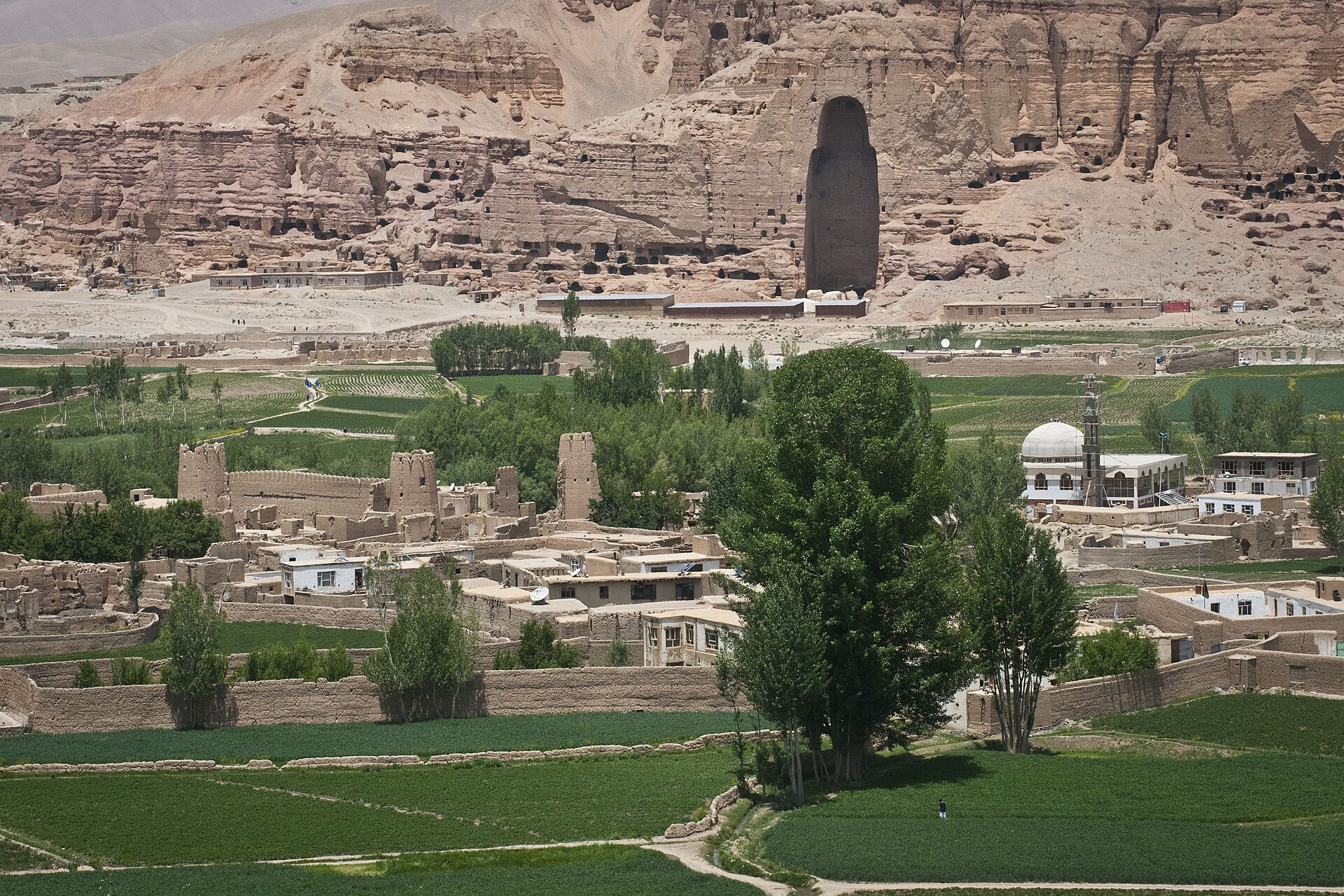
Above the valley, two great niches are hollowed from a red cliff, and between them the rock is honeycombed with caves. Step inside, and blue murals still faint on the ceilings rise into the light — the face of the Buddha, carried from Gandhara to this mountain road, carrying on wall after wall.
Scholarship holds that around the 6th century two colossal standing Buddhas, about 55 and 38 meters tall, were carved into the cliff of the Bamyan Valley in the Hindu Kush, ringed by a monastery of some thousand caves. It is understood as a pass where the Buddhist art of Gandhara and India crossed through Central Asia and eastward along the Silk Road, and the murals surviving on the cave ceilings are said to be among the earliest known oil paintings in the world. The two great statues fell in 2001, leaving the two niches, and the whole valley is a UNESCO World Heritage Site.
Voices across time
“The stone Buddha standing at the mountain's foot rises a hundred and fifty feet — its golden hue flashes, its jeweled ornaments dazzle the eye.”
Field notes
- Location
- Bāmiyān · Afghanistan · N34.8° · E67.8°
- Best time
- Late spring to early autumn, when the light is clear in the valley
- Getting there
- In Bamyan Province, central Afghanistan; from the foot of the cliff along the valley, the two niches and the caves come into view.
- Etiquette
- Respect the murals and local customs, and keep to the marked paths.
Sources
- · UNESCO World Heritage
- · Encyclopaedia Britannica
Photographs are freely licensed works from Wikimedia Commons and similar sources; the author and license appear beneath each image.